8th Activities
Activity 1 : School Backyard Investigation
This activity helps students to learn by observation and exploration.
Activity 2 : Classify it!
Activity 2 : Classify it!
Observe the surrounding of your home and document about new things that you explore
Activity 3 : SoilErosion
Activity 3 : SoilErosion
To explore and verify that soil erosion is affected by the makeup of the soil using plant roots, rocks and the slope of the land as experimental factors.
Activity 4 : Math in Nature
Activity 4 : Math in Nature
Through this activity children uncover their curiosity and will start exploring the Nature and appreciate the beauty due to patterns, Shapes and interesting structure that are there in our surrounding
Activity 5 : 3D Shapes
Activity 5 : 3D Shapes
Use this paragraph to describe what you do.
Activity 6 : Circles and Pi
Activity 6 : Circles and Pi
Activity 7 : Eco-friendly Ganapa
Activity 7 : Eco-friendly Ganapa
Activity 8 : Book reading
Activity 8 : Book reading
Cultivating the reading habit among children through introducing interesting books. And also make them understand the importance of reading book to know the world best.
Activity 9 : Algebraic Identities
Activity 9 : Algebraic Identities
Helps students visualize the algebraic identities through depicting into geometrical shapes/sketches (draw).
Activity 10 : Friction, Inertia and Gravity(FIG)
Activity 10 : Friction, Inertia and Gravity(FIG)
Children will know about Inertia (Newton’s First law of motion), friction and gravity concepts through interesting activities.
Activity 11 : Light
Activity 11 : Light
Activity 12 : Foldscope
Activity 12 : Foldscope
Explore and understand the microscopic world around us using Foldscope(a unique origami application in science, most affordable microscope).
Activity 13 : Microscopic study of Plant and Animal cells
Activity 13 : Microscopic study of Plant and Animal cells
Explore and understand the microscopic world around us using the 'Compound Microscope'.
Activity 14 : Fun Chemistry
Activity 14 : Fun Chemistry
This will make students understand that 'chemistry' is fun to learn and not far from kitchen.
Activity 15 : Float or Sink
Activity 15 : Float or Sink
______________________________________________________________________________
Activity 1 : School backyard investigation
Activity 1 : School backyard investigation
Subject: Environmental science
Time: 2 hours
Objective: To help reinforce students’ ability to ask questions, develop hypotheses, make and record observations during an investigation, and then draw conclusions based on their observations.
Learning outcome:
1) They will start exploring and observing the biodiversity around them.
2) They will brainstorm questions to ask about their outside school grounds, make and record observations, interpret their results, draw conclusions, make predictions, and report their work in the form of a science poster.
Concepts: External features of plants, animals, insects, how to use field guides.
Fundamentals: interest
Teaching aids: Videos, nature walks
Materials Required: Printouts, pocket guides, videos
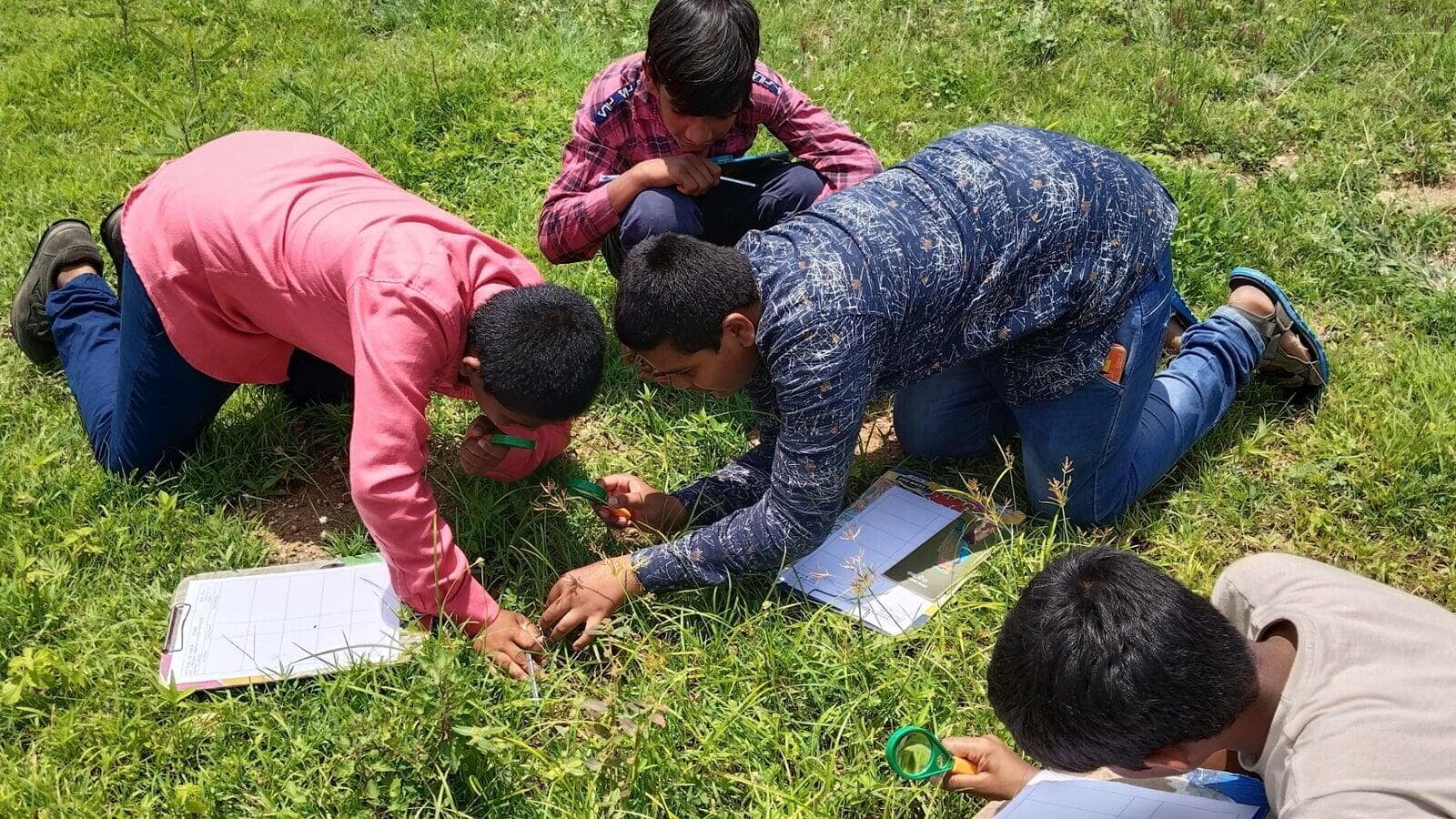
Activity: Nature walk; Discussing variety of plants, birds and insects.
Procedure:
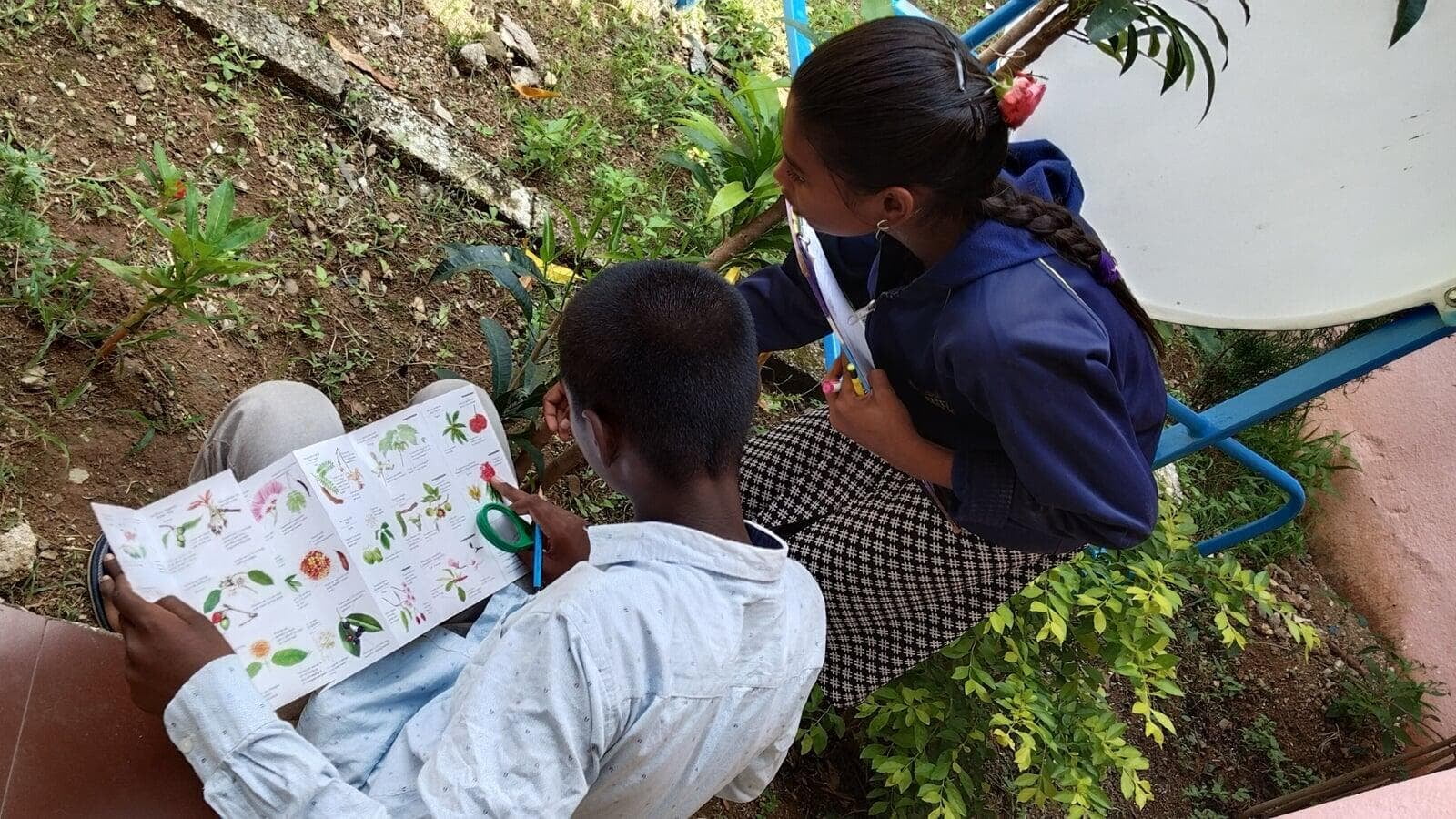
1.After the introduction, distribute the pocket guides and printouts and help them to use them.
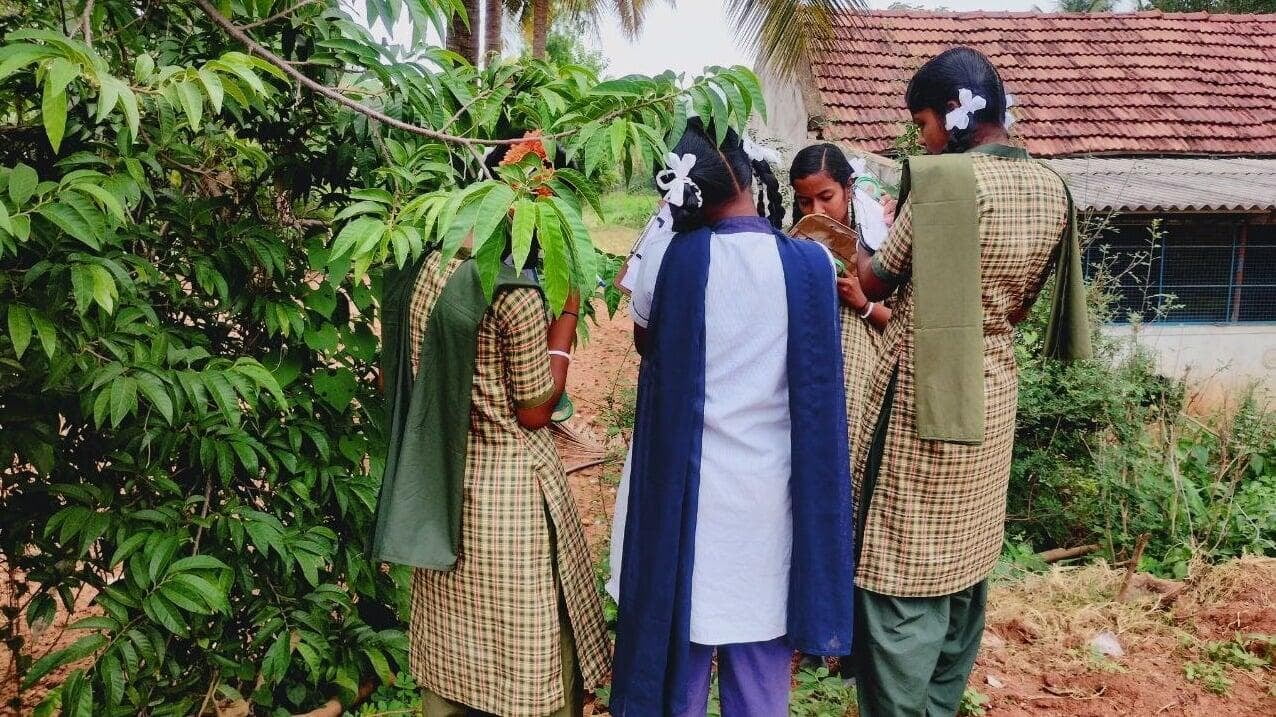
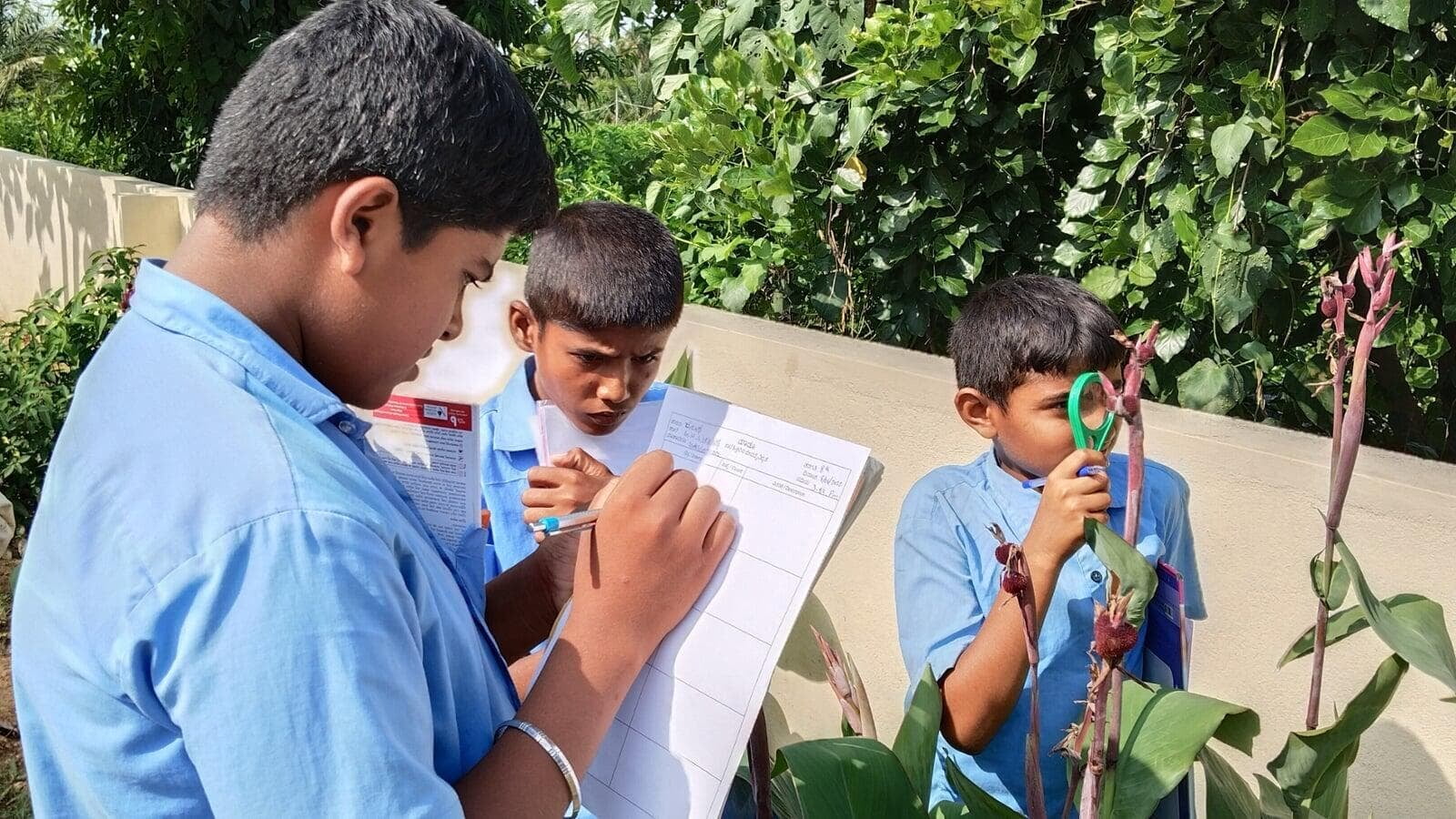
2.Take the children outside the class for a nature walk, ask them to observe things around them like insects, birds,trees and pond ecosystems.
3. Make them document their observations. And discuss it.
4. Ask children to make a school model to depict, What could be done to increase biodiversity in their school surroundings.
Debriefing: Discussing with video.
Take home:
a. Observe the surrounding of your home and document about new things that you explore.
b. Scientist of the activity : Salim Ali (dig into the details of the scientist/achiever in the field and their contributions)
______________________________________________________________________________
Activity 2 : Classify it!
Activity 2 : Classify it!
Subject: Biology
Time: 3 hours
Objective: To show students that many kinds of organisms can be sorted into groups in many ways using various features to decide which organisms belong to which group
Learning Outcome:
1) They will know that diversity of life exists.
2) They will appreciate the importance of diversity in nature and interdependence for their survival.
Value: “Sarve jeevinah sukhino bhavanthu”.
Concept: Classification
Fundamentals: Difference between living and non-living things.
Teaching Aids: Flashcards, animal models, videos, photos.
Materials required: Chart, Thermocol, Clay, samples collected from nature.
Introduction: Story, daily life examples
Ex: 1) Prior activity -Classifying samples collected from nature.
2) Flashcard activity
Discussion followed by videos.
Procedure :
Prior activity : Ask the children to collect natural samples like stones,leaves,flowers and ask them to group those samples and to reason on what basis they have made groups.
Main Activity:
Make childrens into groups, distribute flashcards with birds ,animals,insects,plants. Ask them to group those flash cards based on their observation and to reason it.
Discuss about the characteristic features of plants and animals.
Discuss about vertebrates and invertebrates. Ask them to give examples.
Discuss about the characteristic features of Birds, Fishes,Reptiles, Amphibians and Mammals
Ask children to make a chart and 3 D models of animals using clay.
Debriefing: 1)Why do we classify things?
2) What is classification?
3) Can we classify living organisms? If so how?
Take home:
a. Making 3D animal models based on classification.
b. Scientist of the activity : Find out yourself (dig into the details of the scientist/achiever in the field and their contributions)


______________________________________________________________________________
Activity 3 : Soil Erosion
Activity 3 : Soil Erosion
Subject: Environmental Science
Time: 2 hours
Objective: To explore and verify that soil erosion is affected by the makeup of the soil using plant roots, rocks and the slope of the land as experimental factors.
Learning outcome:
1)They will know the importance of topsoil and reasons for soil erosion and its control measures.
2)They will appreciate the importance of topsoil, and intern the balance between living and non-living resources.
Concept: Soil erosion, Formation of earth and soil, Soil profile.
Fundamentals: Soil formation, Erosion.
Teaching Aid: Activity, Model video.
Materials Required: Trays, pipes ,seeds(Ragi, alasande, hesarukalu)Measuring cylinders, water pouring jug or etc,video.
Introduction:
What are the fundamentals required for life?(Earth formation)
Soil profile(apple demo)
Importance of topsoil
Activity table
Trays | Name of seed | Amount of water |
1 | ||
2 | ||
3 | ||
4 |
Procedure:
Discuss About the different layers of the soil.
Discuss about the importance of topsoil with apple Activity.
Take an apple, ask the children to assume that apple as an earth ,ask them to figure out how much part of it is suitable for farming. As ¾ the part is covered with water, it is not possible for agriculture purpose. Cut the apple into 4 pieces and keep 3 pieces separately to depict the same. Now consider a piece , ask them to predict about the amount of land available for agriculture. Show them that mountains, land covered with ice, roads and buildings are unfit for farming by cutting the piece of apple into many small pieces. With whatever the left out piece of apple , take a thin top layer of apple and make them understand the importance of topsoil available for farming which is a very basic need of all living beings as it serves the food.
Same activity can also be done with onions.
Make the children into groups, provide them a tray and a pipe, ask them to make a hole which fits the pipe and to grow ragi in the first tray ,horse gram in the second tray, black eyed beans(halasandi kalu) in third tray and mixed grains in fourth tray. Give them a period of a week to grow the plants.
Place all four trays and pour water from a distance and collect the water and measure the soil quantity. Tell them to observe and figure out why the amount of soil is different in different trays.
Discuss about the factors that affect topsoil (both natural and manmade) and Methods to prevent soil erosion.
Debriefing : Activity observation and discussion and importance of mixed cropping etc.
Take home:
a. Soil profile model making.
b. Scientist of the activity : Dr. Subbanna Ayyappan (dig into the details of the scientist/achiever in the field and their contributions)


______________________________________________________________________________
Activity 4 : Maths in Nature
Activity 4 : Maths in Nature
Subject: Mathematics.
Time: 2 hours
Objective: Through this activity children uncover their curiosity and will start exploring the Nature and appreciate the beauty due to patterns, Shapes and interesting structure that are there in our surrounding
Learning Outcome:
1) They will know and appreciate the patterns, shapes and symmetry in nature.
2) They will start exploring nature and identify patterns, shapes,structure,symentry ,etc..,
Concepts: Shapes, symmetry, Hemachandra sequence.
Fundamentals: Shapes
Teaching Aid: Puzzle videos, finding the side of a square (hand-out sheets), Sunflower petals and pineapple (hand-out)
Materials required:-Fruits, flowers, seashell, pinecone, vegetable charts, ctayons, photos.
Introduction:-Search patterns in samples collected from nature.
Activity:-Identify the patterns in hand-outs and Discussion.
Procedure :
1.Ask the children where do we see maths in daily life
2.Ask children to collect natural samples and to figure out the shapes,patterns, sequences and symmetry.
3.Give them a hand-out sheet of pineapple and sunflower.
4.Ask them to figure out the pattern.
5. Introduce Hemachandra sequences.
6. Ask them to observe their surroundings and to list all the shapes ,patterns and sequences.
Debriefing: 1) Why there are many shapes, symmetry, patterns in nature.
2) Applications
Take home:
a. Explore the patterns in nature.
b. Scientist of the activity : Acharya Hemachandra (dig into the details of the scientist/achiever in the field and their contributions)


______________________________________________________________________________
Activity 5 : 3D Shapes
Activity 5 : 3D Shapes
Subject: Physics, Mathematics
Time: 2 hours
Objective: To make students understand the basic concepts of geometry and introducing dimensions by making 3D models.
Learning outcome:
1) They will know about dimensions.
2) They will appreciate the advantages of dimensions we live in. .
Concept: Shapes, polygons, Angles, 1D, 2D and 3D.
Fundamentals: Basic geometric shapes.
Teaching Aid: 3D videos,3D images 3D models.
Materials Required: 3D glass, Kg cardboard sheet, scissors, Geometry box(instrument Box), cello tape, 3D Frame, 3D prints.
Introduction: Story “Island story”.
Identifying 3D images in 3D printouts.
Activity: “Construction of 3D polygons.
Procedure:
Start with a Island story
Depict a picture on the board as a boy is standing in the island, ask children to think, what are the possible ways in which he can escape from the Island.
Discuss about shapes, polygons, angles ,dimensions.
Ask children to give examples for 1D,2D and 3D
Construction of 3D models
Draw a circle on a square shaped kg cardboard sheet, refer the below chart with angles to construct the respective polygons
Shapes | Number of sides (n) | Angle 360/ n in degree |
Triangle | 3 | 360/3 = 120 |
Square | 4 | 360/4 = 90 |
Pentagon | 5 | 360/5= 72 |
Hexagon | 6 | 360/6 = 60 |
Octagon | 8 | 360/8 = 45 |
Nonagon | 9 | 360/9 = 40 |
Decagon | 10 | 360/10 = 36 |
Inside a circle, draw a radius and divide a circle with the given angle to get the respective polygon. Example : for triangle ,mark 120 degree ,3 times ,join the end points to get the triangle. Draw rectangles using sides of the triangle as base in all three sides.
Place one more kg card board sheet below and cut the out lines, fold and crease the edges. Insert one triangle inside the other, stick the sides to make it looks like a triangle.
Similarly other shapes can also be done.
Note: heptagon is bit difficult to do as the angle is 360/7=51.43 degree
Debriefing: Comparing different dimensions with 3D models.
Take-home:
a. 3D models using sticks and clay.
b. Scientist of the activity : Find yourself (dig into the details of the scientist/achiever in the field and their contributions)


______________________________________________________________________________
Activity 6 : Circles and Pi
Activity 6 : Circles and Pi
Subject: Mathematics
Time: 2 hours
Objective: Introduce and explore the beauty & universality of pi and math as fun.
Learning outcome:
1) They will know what Pi is and how it remains constant for all circles of any radius.
2) They will explore the beauty and appreciating the universality of Pi and maths as fun.
Concepts: Attributes of circles and Pi, circumference and area.
Fundamentals: Definition of circle
Teaching Aids: Area of circle video, story of wheel video.
Materials Required: Tooth picks, thermocol, woollen threads, kg sheets, scissors ,sketch pens , fevicol.
Introduction:
Draw a circle without mathematical tools (or instruments)
Infinite points, infinite radius.
Curved lines can also be measured.
D=2r
Procedure:
Start with the introduction about shapes.
The wheels concept discusses the advantages and applications of circles in real life.
Ask children to draw circles without any geometry instruments.
Discuss about the basic concepts of circles, i.e. center, radius ,diameter, chord, sector, circumference of a circle.
Arrive at the relation between radius and diameter ,i.e,
diameter(d) = 2 x radius (r)
Relation between circumference and diameter
Circumference = x diameter
Or
Circumference = 2 x radius
With the help of thread, ask children to measure the circumference and diameter of a given circle and ask them to find the ratio of circumference and diameter ,thus find the value of pi.
Similarly measure the circumference and diameter of different circles, and find the ratio of circumference and diameter and tell them to observe the values.
Arrive at a concussion so that the ratio remains the same for all the circles.
Ask children to find the ratio with different circles.
Debriefing:-Application of circles is using video.
Take home:
a. Chart model of circle with tabulated values, diameter, circumference.
b. Scientist of the activity : Aryabhata (dig into the details of the scientist/achiever in the field and their contributions)


______________________________________________________________________________
Activity 7 : Eco-friendly Ganapa
Activity 7 : Eco-friendly Ganapa
Subject: Environmental science & Social Science
Time: 2 hours
Objective:
To protect the environment and humans from harmful effects of chemicals used in making Ganesha Idols.
To celebrate Eco Ganesha festival at home land in a public place by avoiding non biodegradable materials.
Value: Devotion, concern and respect for living beings
Learning outcome:
They will know the intention and importance of festivals celebrated in india.
They will realise the adverse effects of the modern way of celebrating ganesha festival.
Appreciate the traditional way of celebration.
Concepts: Conservation of nature.
Fundamentals: Celebration of ganesha festivals in their surroundings.
Teaching aids: ganesha moulds, videos and photos
Materials Required: clay, colour papers, glue scissors
Activity:
Prior activity :
Discussion on the poem - ‘ಮಣ್ಣಿನ ಗಣಪ ಮಣ್ಣೇ ಗಣಪ'
History of Ganesha festival.
Festivals celebrated in their surroundings.
Main Activity :
DIY - Preparing decorative materials with colour papers, plants colours etc.
Procedure :
We will begin the class by asking questions like,
What is the purpose of celebrating ganesha festival?
How do you celebrate ganesha festival in your locality?
What is the history of ganesha festival?
What are the materials used for decorationWhether this kind of celebration is causing any problems to the environment?
How can we celebrate festivals without harming the environment?
After the discussion as children realise the way it has been wrongly celebrated, they find it is necessary to change the way it is celebrated.Therefore students will use the provided color papers, scissors,glue to make decorative materials for their own Ganesha in an eco-friendly way. In order to avoid excess use of plastic materials in the celebration.
Debriefing: Discussion on celebrating eco friendly Ganesha festival.
Take home:
a. All students will celebrate the Ganesha festival at home or school using materials prepared by them in the class.
b. Scientist of the activity : Dr. Rajendra Singh (dig into the details of the scientist/achiever in the field and their contributions)


______________________________________________________________________________
Activity 8 : Book Reading
Activity 8 : Book Reading
Subject: Kannada Literature
Time: 2 hours
Objective:
Cultivating the reading habit among children through introducing interesting books. And also make them understand the importance of reading book to know the world best.
Value: Respect and patience
Learning outcome:
They will develop the habit of reading.
Children will know that the importance of reading books results in enhancing knowledge, improving vocabulary and communication skills.
Fundamentals: Kannada language to read and understand.
Teaching aids: Books- K.P. Purna Chandra Tejaswi(ಕಾಡಿನ ಕತೆಗಳು), Kanana(e-magazine).
Materials Required: Kannada Books.
Introduction:
Prior Activity:Narrate an exciting story from the series of “ಕಾಡಿನ ಕತೆಗಳು" by K.P. Poorna chandra Tejaswi and ask children to read the book to know the climax if they are curious and interested.
Main Activity: Making groups according to the size of the class and providing interesting books to each group for a given period of time. Students need to read, discuss and understand the story among themselves to narrate the same in front of the whole class.
Take Home:
a. Ask children to read a book of their own interest and write the summary.
b. To weave their own story with the help of any images or subject etc.
c. Scientist of the activity : KP Purnachadra Tejaswi (dig into the details of the scientist/achiever in the field and their contributions)


______________________________________________________________________________
Activity 9 : Algebraic Identities
Activity 9 : Algebraic Identities
Subject: Mathematics
Time: 4 hours
Objective:
- To make students to visualize the algebraic identities through depicting into geometrical shapes/sketches (draw).
Learning outcome:
- They will know the use of Algebraic identities.
- They will appreciate the application of algebraic identities in solving problems.
Concept: Basic mathematical operations of mathematics, constants, variable(unknown), expression, power, equations, area of square and rectangle.
Fundamentals: Basic operations of mathematics.
Teaching Aids: Power of 2 video, story of chess board.
Materials Required: Foam sheets ,kg cardboard sheets ,scissors.
Introduction:
With daily life examples.
Puzzles
Activity(Cutting the kg cardboard)
After the activity children should paste it in the activity sheet.
Procedure:
1. Discuss basic mathematical operations, constants, variables(Unknown), expression, power, equations, area of square and rectangles.
2. Explain them a scenario in which ,brothers need to share their father’s land which is in square shape.depict the same on board explain them about the following identities with the idea of area of square and area of rectangles.
Discuss:
(a+b)2 = a2+2ab+b2
(a-b)2 = a2-2ab+b2
(a+b)2+(a-b)2= 2a2+2b2
(a+b)2-(a-b)2 = 4ab
3. Provide them with kg card board sheets and ask them to cut it into a square of given side.
4. divide square into two squares and two rectangles by drawing lines
5. Ask them to place it in an order to visualize the mathematical identities. And the combinations to get new results.
6. Ask them to paste these pieces in activity sheets.
7. Ask children to make Four charts of the above formula and (a+b) (a-b) expansion using foam sheets.
Debriefing:- Formulae
(a+b)2 = a2+2ab+b2
(a-b)2 = a2-2ab+b2
(a+b)2+(a-b)2= 2a2+2b2
(a+b)2-(a-b)2 = 4ab
Take home:
a. Four chats of the above formula and (a+b) (a-b) expansion.
b. Scientist of the activity : Find yourself (dig into the details of the scientist/achiever in the field and their contributions)


______________________________________________________________________________
Activity 10 : Friction, Inertia and Gravity(FIG)
Activity 10 : Friction, Inertia and Gravity(FIG)
Subject: Physics
Time: 4 Hours
Objective: Children will know about Inertia (Newton’s First law of motion)
Friction , as a force that opposes the motion. And an object for which air resistance or friction is important will descend more slowly than it would, when moving under the influence of gravity alone.
Learning outcome:
1)Students will know that the text book physics is seen in all walks of life.
2)They will appreciate that even walking is because of friction which is physics bounded by gravity and stops by inertia.
3)Observe through physics eyes.
Concepts: Inertia, Friction and Gravity ,Laws of motion, Weight and mass.
Fundamentals: Motion, Weight, Rest.
Teaching Aids : Activities, Videos, discussions and worksheets.
Materials Required:
1) Pull a coin: coins , paper, tumbler(glass)
2) Friction pulley Experiments:-pulley, plywood sheets, Sand paper, smooth papers
3) Gravity: Two different weighted balls, drop test (slow motion video)
Introduction :
Why is it difficult to climb uphill?
When you are running how do you stop? What happens while stopping?
Why is it feeling like falling when you stop suddenly in a long jump?
Activities:
1) Pull a coin and Run and stop.
2)Pull a book by weight balls.
3)Drop test of two different weight balls.
Inertia :
Pull a coin : Take a kg cardboard sheet, place a coin on it ,place this kg cardboard sheet on the glass, pull a coin in such a way that the coin should drop into glass.
Ask them how it works and discuss Inertia and Newton’s first law of motion.
Friction :
Run and stop : make children stand in a line ,make them run and ask them to stop when they are instructed to stop.
Ask them what they experience, when they were instructed to stop while running.
Friction pulley experiment : take a play wood, paste rough and smooth surfaces say sand paper and cloth, make a hole and tie a thread so that it is easy to drag it like a pulley. On the wall below the window mark the scale to measure the height. Place objects like eraser, duster (and any other objects which are available in the class)on rough surface (sand paper) and lift it using a thread through window grill. Note the height at which the object tends to fall, repeat the same on Smooth surface(cloth) and note down the height.
Ask children to draw a double bar graph depicting the height at which object falls on both the surfaces.
Discuss about friction, advantages and disadvantages.
Gravity :
After the introduction, ask children to test two objects dropping at a time.
Free fall activity : Ask the children to hold two objects in two hands at a distance and to predict which falls first, then to drop them at a time. And to figure out the reason.
Discuss what happens in the absence of air.
Debriefing:
Through video debrief the activities done.
Use the second data available in 2nd activity to write a graph and analyze.
General discussion
Take home:
a. Brainstorming question.
b. Scientist of the activity : Find yourself (dig into the details of the scientist/achiever in the field and their contributions)
______________________________________________________________________________
Activity 11 : Light
Activity 11 : Light
Subject: Physics
Time: 4 hours
Objective:
Children will know that different types of objects reflect different amounts of light. In addition to reflection, light also can be partially absorbed or transmitted by an object.
They will also explore, when light passes at an angle from one medium to another, like air to water, it bends. Kids will learn about the phenomenon of Rainbow formation (Total internal reflection, dispersion of light)
Learning outcome:
1) They will know about that light, also a form of energy and properties of light.
2) They will appreciate applications of Light in daily life.
Concept: Light as a form of energy, Rectilinear property of light, properties of light- Reflection ,Refraction ,Dispersion of light, colours, scattering of light, Rarer and denser medium.
Fundamentals: Importance of light
Teaching Aids: Videos
Materials Required:-Glass rod (total internal reflection), glass containers, optic fibers, lasers, mirrors, torch, prism, empty prism/medium, glass slab.
Introduction:
Prior activity: skit, poems, story and asking and preparing riddles related to light
Q: Why do we see objects?
Q: On scattering of light.
Activity a): Symmetry
H.W: A-Z Find letters which are symmetrical.
Activity b): Focus/ Catch me!
Passing the light
Activity c): Activity on angle of incidence and angle of reflection.
Q: Straight pipe and curved pipe
Refraction:
1) Broken stick experiment
2) Touch the coin experiment
Mediums, speed of light in different mediums
Home Work :
Q1: How is the rainbow formed?
Q2: Why is the sky blue?
Q3: Why is the sky red during sunrise and sunset?.
Colours:
Q1:How do we see different colours?
Prism activity and discussion
Dispersion
Scattering
Speed of different colours.
Reflection:
Find the word : write a word on the board which has vertical symmetry, challenge the children to guess the word.
Ask the children to list all the alphabets which are symmetrical.
Catch the light: Make the children into groups, provide them mirrors, challenge them to pass the light through mirrors and to spot the light on the object of interest.
Angle of incidence = Angle of Reflection
Make children into groups. Provide them a mirror and a laser.
Ask children to draw a line on a paper and to place a mirror on that line.
Let one of them pass the light through a laser on the mirror and draw dotted lines to show the incident ray on the paper.put a dot where light ray meets the mirror. Again draw dotted line to show the reflected ray.
Draw a perpendicular through the point of incident to the initially drawn line.
Now measure the angle of incidence and angle of reflection and note it .
Repeat the same for different angles.
Angle of incidence | Angle of reflection |
.
Refraction:
Broken stick Experiment :- take a glass of water and place a stick. Ask children what they observe.
Touch the coin experiment : place a coin in a glass of water(glass)
Ask the children to touch the coin by looking at it from different directions.
Discuss about transparent, opaque and translucent media, speed of light in different mediums.
Dispersion of Light :
Prism Experiment: Ask the children to hold a prism to sunlight and ask them to reason out why that light is splitting into colours.
Discuss about rainbow formation.
Take home:
a. How to make a Kaleidoscope.
b. Scientist of the activity : Narinder Singh Kapany (dig into the details of the scientist/achiever in the field and their contributions)
______________________________________________________________________________
Activity 12 : Foldscope
Activity 12 : Foldscope
Subject: Biology
Time: 2 hours
Objective: To explore and understand the microscopic world around us using Fold scope.
Learning outcome: They will know and appreciate the diversity in the microscope.
Value:- ಕೇಳಿದ್ದು ಸುಳ್ಳಗಬಹುದು, ನೋಡಿದ್ದು ಸುಳ್ಳಾಗಬಹುದು, ನಿಧಾನಿಸಿ ಸ್ಮೂಕ್ಷ್ಮವಾಗಿ ಪರೀಕ್ಷಿಸಿ ಯೋಚಿಸಿದಾಗ ನಿಜವು ತಿಳಿವುದು.
Concepts: Living, non-living, microorganisms, unicellular, multicellular organisms.
Fundamentals: Microorganisms, living and nonliving.
Teaching Aids: Fold scope teacher’s kit, permanent slides.
Materials Required: Fold scope , samples, slide Field culture-paramecium, Euglena
Introduction: Link something to the microscopic world.
Eg:- What do you see in the class?
Discussions on unicellular and multicellular, difference and characteristics.
Activity: Field visit, sample collection.
Introductions:- How to use Fold scope.
They have to document whatever they see on field like, drawing, features
Procedure:
After the introduction , distribute the foldscope, explain to them how it works and guide them to use it.
Ask the children to collect the natural samples like dead insects ,flower pollens, and any object which can be viewed through foldscope.
Help them to make slides, and to insert it in a slide slot.ask them to observe the sample exposing foldscope to lightsource.
Ask children to exchange the foldscopes and to observe the samples.
Provoke children to think about any device which they can design so that it works like foldscope.
Debriefing: Conclusion, permanent slides, Importance of studying the micro world.
Take-home:
a. Collecting samples from their surroundings.
b. Scientist of the activity : Find yourself (dig into the details of the scientist/achiever in the field and their contributions)
______________________________________________________________________________
Activity 13 : Microscopic Study of Plant and Animal Cells
Activity 13 : Microscopic Study of Plant and Animal Cells
Subject: Biology
Time: 4 hours
Objective: To explore and understand the microscopic world around us using the Compound Microscope.
Learning outcome: They will know and appreciate the diversity in the microscope.
Value: Respecting microscopic organisms, ಕೇಳಿದ್ದು ಸುಳ್ಳಗಬಹುದು, ನೋಡಿದ್ದು ಸುಳ್ಳಾಗಬಹುದು, ನಿಧಾನಿಸಿ ಸ್ಮೂಕ್ಷ್ಮವಾಗಿ ಪರೀಕ್ಷಿಸಿ ಯೋಚಿಸಿದಾಗ ನಿಜವು ತಿಳಿವುದು.
Concepts: Living, non-living, microorganisms, unicellular, multicellular organisms.
Fundamentals: Microorganisms, living and nonliving.
Introduction: Link something to the microscopic world.
Activities :
i) Onion peel Experiment:
Materials: Safranin stain, salt, forceps, paint brush ,distilled water, watch glass, slides, cover slips, microscope, onion ,blade, needles, tissue paper, dropper .
Procedure:
Take a small piece of onion bulb with the help of a forceps, peel off a thin layer from the inner side of the onion.
Place immediately in the watch glass containing distilled water.
Take a cleaned slide, put a drop of water in the water.
Transfer the small piece of peel on the drop of water with the help of brush.(Make sure that the peel is perfectly flat)
Add a drop of safranin solution on this piece followed by a cover slip.
Observe the slide under the microscope.
ii) Cheek cell Experiment:
Materials: Ice cream sticks, slides, Methylene blue, cover slip, cheek cells, distilled water, needle ,microscope.
Procedure:
Take a glass slide; put a drop of water on it.
Using an Ice-cream spoon, gently scrape the inner surface of the cheek.
With the help of a needle, transfer the material and spread it evenly on the glass slide.
Put a drop of Methylene blue stain on it.
Place a cover slip on it.
Observe the slide under the microscope.
Debriefing: Discussion with slides prepared.
Take home:
a. Make a model of plant and animal cells.
b. Scientist of the activity : Arunkumar Sharma (dig into the details of the scientist/achiever in the field and their contributions)
______________________________________________________________________________
Activity 14 : Fun Chemistry
Activity 14 : Fun Chemistry
Subject: Chemistry
Time: 2 Hours
Objective: Make Students understand that Chemistry is fun to learn and not far from kitchen .
Learning outcome: Students will know how basic chemistry is used in daily life,even in kitchen .
For example: Fermentation of milk into curd.
Appreciate acids and bases that we use in our daily life.
For example: Lemon juice(acid), soda(basic)
Value: “Don’t judge a book by it’s cover”.
Concepts: combustion, oxidation, osmosis,thermal decomposition, homogeneous and heterogeneous solution, Chemical and physical changes.
Fundamentals: Chemical reactions,
Activities:
1)Invisible ink:
Materials: Lemon, Swab, water, paper, light source, glass, knife, cutter, candle, match box.
Procedure: Squeeze the lemon juice into the saucer. Add few drops of water and mix well.
Dip the swab in lemon juice, then use the swab to write a message on ordinary white paper.
When it dries, the writing will be invisible. When you want to read the message, heat the paper holding it near a light source.
2) 1 + 1 is not equal to 2:
Materials: Beakers, rubbing Alcohol, water, measuring cylinder, food colour.
Procedure: Measure 15ml of water and pour into a beaker. Mark the level of water as 1.
Again measure 15ml of water and pour into the same beaker. Mark the level of water as 2.empty the beaker.
Explain the experiment and ask to predict.
Now measure 15ml of water, add 2 drops of food colour and pour it into the beaker(marked).add 15ml of mystery liquid(Alcohol) and ask them to predict the level of the new mixture.
3) Save my Apple:
Materials: Knife, apple, lemon, plate, soap water, vinegar, soda.
Procedure: Cut the apple into many parts; put the apple pieces on plate. Then apply the pieces with lemon, soap water, vinegar, soda on separate pieces,let it stand for 2 hours.
3) Carbon Sugar snake:
Material: Sugar,baking soda,water,sand,tin /plate,matchbox,bowl,spoon,spatula.
4) Sugar is the solution:
Materials: 2 Glasses, glass rod,food colour,sugar,water.
Procedure: Take 2 glasses of water ,add 2 tablespoon of sugar to one of these 2 glasses .Mix well to form a homogeneous solution. Then add 4 drops of food colour to both the glasses. And observe .Now try mixing the 2nd glass and observe.
5) Osmosis:
Materials: 2 potatoes,2 head pins,2 bowls ,water, sugar/salt, peeler
Procedure: Take 2 potatoes, peel the skin, make a hollow cavity at the centre .
Take 2 bowls,mark them A and B, fill the 2 bowls with tap water, place a potato half filled with sugar solution in bowl A and place a potato half filled with tap water and place it in bowl B. Mark the level of solution in each potato using a pin, allow it to stand for 2 hours, then observe the changes.
Debriefing: Discussing about activities mentioned above
Take home:
a. Repeat the same experiment by reversing the liquids in bowl A ( tap water in potato, sugar solution in bowl).
b. Scientist of the activity : Find yourself (dig into the details of the scientist/achiever in the field and their contributions)
______________________________________________________________________________
Activity 15 : Float or Sink
Activity 15 : Float or Sink
Subject: Physics
Time: 2 Hours
Objective:.
To enable children to understand the basic concept of displacement, density, volume.
Learning Outcome:
1)Children will know what makes an object float or sink.
2)They will appreciate the applications of float or sink in real life.
3)They will observe and analyse the principles behind floating or sinking.
Concepts: Displacement, Density,mass,volume,buoyancy ,density of various liquids
Fundamentals: Basic idea about objects that sink or float.
Teaching Aid: Videos about The principles of Float or sink
Materials: Materials available in class like pencils,eraser,scale,foil,orange,oil,cork,wooden block,pins,balloon,ball,rubix cube,iron,wood.
Introduction: Story “Dove and Ant”
Activity: Students will investigate floating and sinking with the range of objects.
Students should make and test the prediction about the object that will float or sink.
Objects | Prediction before activity Float or Sink | Float / sink After the activity | Reason |
Students will make a model of density column
Procedure :
Ask the children why things float or sink.
Ask children to predict whether the given object floats or sink and to tabulate it with reason.
Ask them to examine by dropping objects into a bucket of water and to arrive at a conclusion.
Debriefing: Students will understand some concepts commonly observed in daily life. Examples: Floating of Ships, dead bodies, Icebergs, Fish and about submarines.
Take home:
a. Density column Experiment
b. Density related calculation to confirm whether the object floats or sinks.
c. Scientist of the activity : Find yourself (dig into the details of the scientist/achiever in the field and their contributions)